

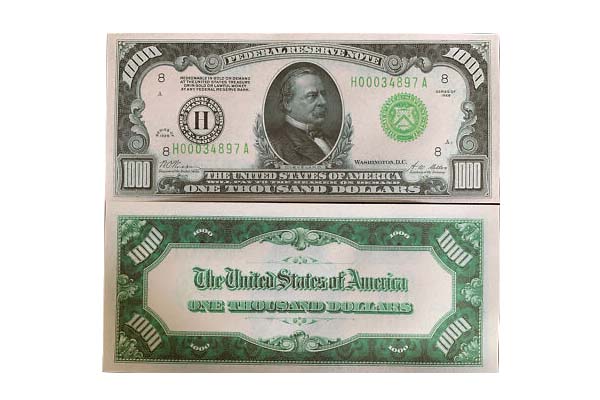
Un véritable billet de 1 000 $ vaut bien plus que sa valeur nominale. La plupart sont évalués à 1 600 $ à plus de 3 000 $1, en fonction de leur état. Des exemples particulièrement rares, comme "notes d'étoiles2" ou des billets de la série 1928 en parfait état – peuvent se vendre des dizaines de milliers de dollars3.
Ces billets sont considérés comme des objets de collection. Leur valeur est influencée par plusieurs facteurs : la rareté, l'état, l'année de la série et la banque de réserve fédérale émettrice. En ce sens, ils ressemblent davantage à des objets historiques ou à des œuvres d’art qu’à une simple monnaie.
Facteurs clés qui affectent la valeur
1. État
L’état joue un rôle majeur dans la détermination de la valeur d’une facture. Les collectionneurs utilisent une échelle de notation allant de « Bon » (fortement circulé avec une usure notable) à « Non circulé » (pas de plis, de plis ou de signes d'utilisation). Les billets en état non circulé peuvent valoir plusieurs fois plus que les exemplaires usés.
2. Année de la série
Les deux séries les plus courantes pour les billets de 1 000 $ sont 1928 et 1934. Généralement, les billets de 1928 sont plus rares et plus précieux en raison de taux de survie plus faibles.
3. Notes d'étoiles
Les factures avec une petite étoile (*) à la fin du numéro de série sont appelées notes d'étoiles. Ceux-ci ont été imprimés pour remplacer les factures mal imprimées et sont nettement plus rares. En conséquence, ils bénéficient généralement d’une prime parmi les collectionneurs.
Légalité des billets de 1 000 $
Contrairement à une idée reçue, posséder un billet de 1 000 $ est complètement légal. Le gouvernement américain a cessé d’imprimer des billets de grande valeur en 1945 et leur utilisation officielle a été interrompue en 1969. Cependant, ils ont toujours cours légal et peuvent être détenus ou collectés sans aucun problème juridique.
Pourquoi la production s'est arrêtée
Le gouvernement a abandonné ces projets de loi en raison de leur utilisation limitée et des inquiétudes croissantes quant à leur utilisation potentielle dans des transactions illégales. L’évolution vers les virements bancaires électroniques a également rendu les factures de grosses coupures moins nécessaires. En 1969, le président Nixon mit officiellement fin à leur distribution.
Cours légal et utilisation pratique
Bien que les billets de 1 000 $ aient techniquement cours légal, leur utilisation dans les transactions quotidiennes n'est pas pratique. La plupart des entreprises ne les accepteraient pas en raison de préoccupations concernant la contrefaçon et le manque de changement. Les banques doivent les honorer, mais leur valeur réside dans le marché des collectionneurs.
Authentification
En raison de leur valeur, les billets de 1 000 dollars sont fréquemment la cible de contrefaçons. Vérifier l’authenticité est essentiel. Les négociants en devises certifiés et les services de notation peuvent confirmer la légitimité grâce à des analyses d'experts et à des fonctionnalités de sécurité.
Qui figure sur le billet de 1 000 $ ?
Les billets de 1 000 $ les plus courants, des séries 1928 et 1934, comportent Président Grover Cleveland, le seul président américain à avoir exercé des mandats non consécutifs (22e et 24e). Les versions antérieures présentaient d'autres personnages historiques.

Autres chiffres présentés
Tout au long de l’histoire, différents billets de 1 000 $ ont représenté divers Américains éminents :
| Année / Série | Portrait | Type de note |
|---|---|---|
| 1862-1863 | Robert Morris | États-Unis Remarque |
| 1878, 1880 | DeWitt Clinton | Certificat Argent |
| 1890 | Georges Meade | Billet du Trésor |
| 1918 | Alexandre Hamilton | Billet de la Réserve fédérale (grand) |
| 1928, 1934 | Grover Cleveland | Billet de la Réserve fédérale (petit) |
L’année spécifique et le type de facture influencent fortement sa valeur. Par exemple, un billet de 1 000 $ d'Alexander Hamilton de 1918 est un billet de grande taille et nettement plus précieux que les billets de Cleveland plus petits et plus courants.
Recouvrement des billets de 1 000 $
Oui, les billets de 1 000 $ sont hautement recouvrables. Leur rareté, leur importance historique et leur conception détaillée les rendent recherchés par les collectionneurs.
Qu’est-ce qui motive le marché des collectionneurs ?
Rareté
La Réserve fédérale détruit régulièrement tous les billets de grande valeur qu'elle reçoit, réduisant ainsi le nombre d'exemplaires survivants et augmentant leur rareté et leur valeur au fil du temps.
Importance historique
Chaque facture reflète une époque historique où les transactions importantes en espèces étaient plus courantes. Ce lien avec le passé ajoute à leur attrait pour les collectionneurs.
Artisanat
Ces billets sont des exemples de gravure habile et de conception de monnaie classique. De nombreux collectionneurs les apprécient non seulement comme monnaie, mais aussi comme œuvres d’art monétaires.
Les banques peuvent-elles accepter les billets de 1 000 $ ?
Techniquement, oui. Les banques sont tenues d'honorer les billets de 1 000 $ à leur valeur nominale. Toutefois, cela n’est pas recommandé.
Que se passe-t-il si vous en déposez un ?
La plupart des caissiers de banque n’ont jamais manipulé un billet de 1 000 $. Attendez-vous à des retards, à des étapes de vérification supplémentaires et peut-être même au dépôt d'un rapport d'activité suspecte (SAR), même s'il n'y a eu aucun acte répréhensible. Une fois déposée, la facture est généralement envoyée à la Réserve fédérale et définitivement retiré de la circulation.
De meilleures alternatives
Pour préserver et maximiser sa valeur, considérez les éléments suivants :
- Obtenez une évaluation – Un marchand de devises professionnel ou un numismate peut évaluer l’authenticité et l’état du billet.
- Vendre à un collectionneur – Faites appel à un revendeur ou à une maison de ventes aux enchères réputé pour vendre la facture à sa véritable valeur de collection, souvent bien supérieure à 1 000 $.
Conclusion
Un billet de 1 000 $ est bien plus qu’une simple monnaie. C’est un artefact de collection de l’histoire financière américaine. Bien qu’elle ait toujours cours légal, sa véritable valeur réside dans sa rareté, son histoire et son design. Avant d’en dépenser ou d’en déposer un, consultez un expert pour vous assurer de bien comprendre sa pleine valeur marchande.
-
Explorez ce lien pour comprendre l'évaluation des billets de 1 000 $ en fonction de leur état et de leur rareté. ↩
-
Comprendre l'importance des billets vedettes sur le marché des collectionneurs et leur rareté. ↩
-
Découvrez les facteurs qui peuvent augmenter considérablement la valeur des rares billets de 1 000 $. ↩