

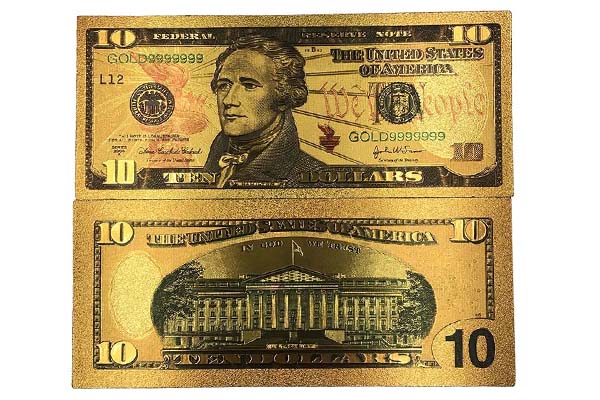
Gold-colored $10 bills that appear to be currency are not legal tender issued by the U.S. government. These items are privately manufactured collectibles. They are typically made from base metals like brass and coated with a thin layer of real gold.
Although the U.S. has issued Gold Certificates1 in the past—paper notes redeemable for gold—it has never produced circulating currency made from gold or plated metals. Modern gold-style bills are artistic interpretations created for collectors, brands, and corporate clients. Their function is commemorative, not financial.
These items hold value based on their design, materials, and association with intellectual property. Manufacturers work with partners across industries to create limited-edition metal banknotes2. These are produced using detailed molding, gold plating, and advanced finishing techniques, offering collectors items with visual appeal and symbolic worth. Their value depends on brand partnerships, artistic quality, and scarcity—not their denomination.
What's the Rarest $10 Bill?
Among real U.S. currency, one of the rarest $10 bills is the Series 1878 or 1880 $10 Silver Certificate, known as the "Jackass Note." The nickname comes from an eagle image on the back that, when viewed upside down, resembles a donkey's head.

This design was replaced quickly due to public criticism, making surviving notes rare. Its limited circulation adds to its collectible value3 today. In contrast, modern collectible banknotes are designed with rarity in mind from the start.
What Makes a Banknote Rare?
Rarity in historical notes and modern collectibles stems from different factors. Here's a comparison:
| 特徴 | Historical Banknotes (e.g., Jackass Note) | Modern Collectible Metal Banknotes |
|---|---|---|
| 希少性 | Low original print runs and loss over time | Intentionally small production runs (e.g., 500 units) |
| デザイン | Important events, portraits, or controversial elements | Licensed IP from film, anime, or artists |
| 状態 | Graded by preservation level, e.g., Uncirculated | Mint condition is standard, emphasis on flawless finish |
| Special Features | Printing errors and serial number anomalies | Added effects like holograms, serial numbers, micro-text |
Modern Collectible Creation Example
To create exclusivity, some manufacturers produce limited quantities of metal banknotes for specific audiences. One example includes a Japanese anime-themed "Cyber Samurai" note—50,000 units for a global fan event. Features like holography and serial numbers added uniqueness and verification to each item.
How Much Is a Gold $10 Collectible Worth?
The value of a gold-plated $10 note comes from its materials and appeal to collectors. It is not tied to the bill’s face value or precious metal content.
Material value is minimal, while collectible value can be much higher.
Intrinsic vs. Collectible Value
Intrinsic Value:
- Base Material: Typically brass or zinc alloy, chosen for durability and detail.
- Gold Plating: A thin layer of genuine 24K gold—usually only a few microns thick—is used. The actual amount of gold is very small, often valued at just a few dollars.
Some premium projects use thicker plating (up to 3 microns), increasing both cost and perceived luxury.
Collectible Value:
This is influenced by design quality, licensing, and how well the product connects with a target audience.
| Factor | 説明 | Example Use Case |
|---|---|---|
| Licensed IP | Links to recognizable franchises or brands | Officially licensed sci-fi note for a film premiere |
| Production Quality | Detailing and print technology | Micron-level engraving and fade-resistant PrintGuard™ tech |
| Edition Size | Limited runs drive exclusivity | Short-run editions for high-end clients starting from 100 units |
| 認証 | Anti-counterfeiting technology | Holograms and blockchain certificates |
| パッケージング | Presentation enhances appeal | Eco-friendly wood boxes for corporate gifts |
In most cases, a collectible’s market price reflects the sum of its perceived artistic and brand value, not its raw materials.
How to Spot a Fake $10 Bill?
For standard U.S. paper currency, identifying counterfeit bills involves checking for built-in security features.
A real $10 bill includes raised printing, a watermark of Alexander Hamilton, a security thread, and color-shifting ink.
U.S. $10 Bill Security Features
- Raised Printing: The portrait of Hamilton should feel slightly raised due to the intaglio printing process.
- Watermark: A faint image of Hamilton appears to the right of the portrait when held to light.
- Security Thread: Embedded in the bill and glows orange under UV light. It reads “USA TEN.”
- Color-Shifting Ink: The "10" in the bottom right corner changes color from copper to green when tilted.
Security in Metal Banknotes
Some collectible manufacturers adopt similar anti-counterfeiting measures:
- Micro-Text Engraving: Very small text used for authenticity, similar to real currency.
- Holographic Layers: Provide visible, hard-to-duplicate validation.
- Controlled Production: Using in-house manufacturing ensures IP protection.
- Unique Serial Numbers: Help verify item authenticity and edition limits.
By combining these elements, collectible producers safeguard both the value and authenticity of their products.
結論
A gold-colored $10 bill is not real currency, but it can be a valuable collectible when designed with artistic integrity, licensed IP, and quality materials. Real $10 bills include advanced security features, and similar principles apply to collectible metal notes to ensure they maintain credibility and worth in the eyes of collectors.
-
Explore the history of Gold Certificates to understand their role in U.S. currency and their collectible value. ↩
-
Find out why limited-edition metal banknotes are sought after by collectors and how they are produced. ↩
-
Discover the key elements that determine the collectible value of banknotes, enhancing your understanding of numismatics. ↩