

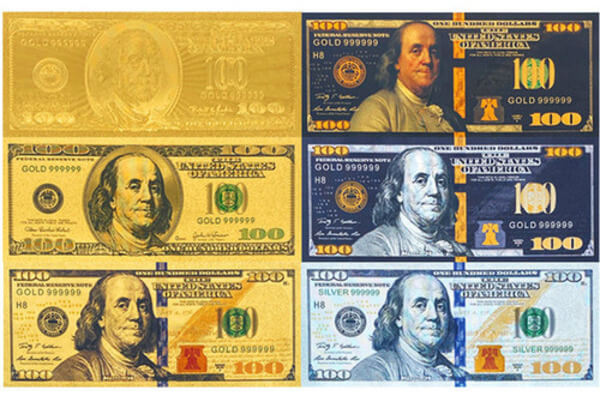
Goudkleurige biljetten van $ 100 zijn opvallend, maar zorgen vaak voor verwarring over hun werkelijke waarde. Zijn het waardevolle beleggingen of decoratieve souvenirs? Hier is een objectieve blik op wat ze echt waard zijn.
Meest vergulde biljetten van 100 dollar1 zijn slechts een paar dollar waard. Hun waarde ligt in nieuwheid of verzamelbaarheid, niet in het goudgehalte. Limited editions en high-end versies kunnen meer waard zijn op basis van vakmanschap, zeldzaamheid en licenties.
De term ‘goudbiljet’ omvat een grote verscheidenheid aan items, van goedkope toeristische souvenirs tot op maat gemaakte verzamelobjecten in beperkte oplage, gemaakt voor high-end klanten. Een in massa geproduceerd nieuwigheidsbiljet van $ 10 verschilt aanzienlijk van een verzamelobject gemaakt met geavanceerde technieken en hoogwaardige materialen. De waarde is afhankelijk van materialen, productiekwaliteit en licentierechten.
De meeste van deze bankbiljetten zijn niet gemaakt van massief goud. In plaats daarvan zijn ze meestal voorzien van een onedel metaal (zoals messing of plastic) met een dunne laag goudkleurige folie of beplating. De werkelijke waarde varieert afhankelijk van hoe en waarom de factuur is gemaakt.
Soorten goudbiljetten van $ 100
1. Nieuwheidsrekeningen voor de massamarkt
Deze zijn gebruikelijk en worden verkocht via online winkels en cadeauwinkels. Ze zijn vaak gemaakt van plastic of onedele metalen met een minimaal goudgehalte. Deze artikelen worden doorgaans verkocht voor $ 5 tot $ 20 vanwege hun nieuwe aantrekkingskracht.
2. Verzamelbiljetten in beperkte oplage
Deze items, geproduceerd in kleine batches met serienummers en gelicentieerde ontwerpen, zijn aantrekkelijk voor verzamelaars. Ze kunnen microgravures of holografische kenmerken bevatten. Afhankelijk van het merk of het verhaal dat eraan verbonden is, kunnen ze variëren van $ 50 tot enkele honderden dollars.
3. Hoogwaardige herdenkingsmunt & Relatiegeschenken
Deze rekeningen bevatten echte 24K vergulden2 met een dikte van 3 micron of meer. Hun waarde – soms honderden of duizenden dollars – komt voort uit vakmanschap, authenticiteit en presentatie, en niet alleen uit het materiaal.
Zijn gouden biljetten van $ 100 hun gewicht in goud waard?
Nee. Het goudgehalte in de meeste vergulde biljetten van 100 dollar is minimaal en heeft weinig materiële waarde. Het basismetaal vormt bijna het gehele gewicht van het biljet.
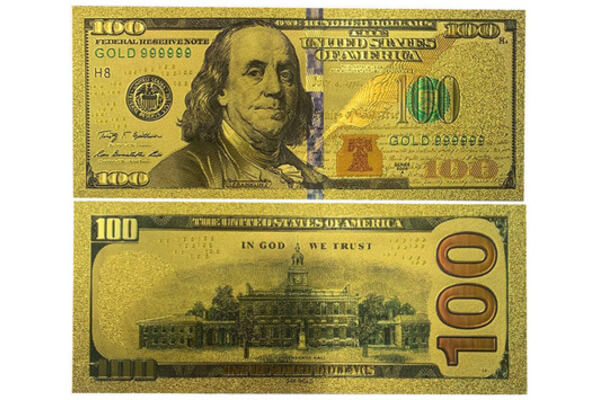
Het vergulden begrijpen
Het vergulden is extreem dun, meestal minder dan 0,5 micron. Een biljet van 30 gram met een coating van 0,5 micron bevat slechts een paar cent aan goud. De waarde ligt in het ontwerp en de verzamelbare aspecten, niet in het metaal.
Soorten gouden afwerking
- Verguld/goud gelaagd: Elektrochemisch aangebracht goud op een onedel metaal.
- Goudfolie / bekleed: Een gebonden dun vel goudfolie - dikker dan beplating maar nog steeds een oppervlaktebehandeling.
- Massief goud: Het hele item is gemaakt van een goudlegering. Zeldzaam en duur voor items van dit formaat.
Zelfs bij artikelen van hoge kwaliteit is meer dan 99,9% van de materiaalwaarde vaak afkomstig van het basismetaal en het productieproces, en niet van de goudlaag.
Waar komt de echte waarde vandaan?
De waarde van een verzamelobject hangt meer af van het verhaal en de constructie dan van de materialen. Dit zijn de belangrijkste waardedrivers:
| Waardefactor | Beschrijving | Waarom het ertoe doet |
|---|---|---|
| Intellectueel Eigendom (IE) | Licentierechten voor populaire merken, films of personages. | Voegt emotionele en culturele waarde toe voor fans. |
| Vakmanschap & Detail | Hoogwaardige gravering, kleurnauwkeurigheid en afwerking. | Verhoogt de waargenomen waarde en kwaliteit. |
| Beperkte editie-status | Genummerde productieruns met kleine aantallen. | Creëert exclusiviteit en stimuleert de interesse van verzamelaars. |
| Beveiligingsfuncties | Hologrammen, microtekst of geavanceerde anti-namaaktechnologie. | Bevestigt authenticiteit en voegt geloofwaardigheid toe. |
| Certificaat van echtheid | Geverifieerde documentatie van de maker. | Ondersteunt de verkoopwaarde en het vertrouwen van de koper. |
Hoe weet u of een gouden biljet van $ 100 echt is?
Controleer op een Certificaat van echtheid3 en evalueer het vakmanschap. Authentieke stukken hebben gedetailleerde afwerkingen en duidelijke kenmerken. Goedkope imitaties zien er vaak vlak of wazig uit.
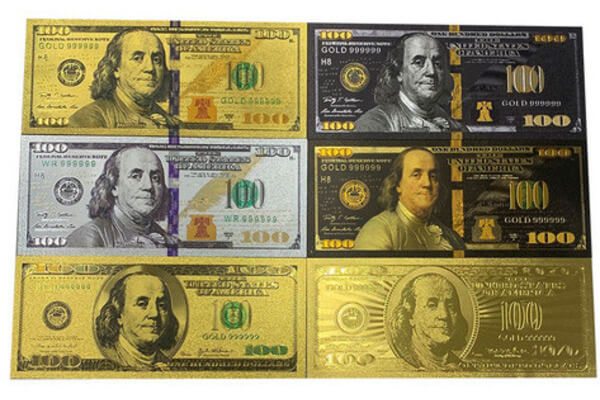
Zoek naar de juiste documentatie
Een echt verzamelbiljet moet een Certificaat van Echtheid (COA) bevatten met:
- De naam van de uitgevende instelling (fabrikant of IP-houder)
- Materiaaldetails (bijvoorbeeld ‘24-karaats verguld messing’)
- Afmetingen en gewicht
- Een uniek serienummer dat overeenkomt met de factuur
Rode vlaggen:
- Generiek of ontbrekend COA
- Geen specifieke informatie over materialen of herkomst
Sommige premiumproducten bevatten nu blockchain-verificatie voor het volgen van de authenticiteit.
Onderzoek de fysieke kwaliteiten
| Functie | Hoogwaardig verzamelobject | Souvenir van lage kwaliteit |
|---|---|---|
| Gravure | Diepe, scherpe lijnen met voelbare textuur | Platte of wazige afdruk |
| Kleurafdruk | Helder, schoon en goed uitgelijnd | Dof, niet goed uitgelijnd of gemakkelijk te krassen |
| Oppervlakte -afwerking | Soepel en consistent, spiegelachtig indien bedoeld | Ongelijkmatige, bekraste of troebele afwerking |
| Gewicht & Gevoel | Stevig en solide | Dun, licht of plasticachtig |
| Beveiligingsfuncties | Echte hologrammen en microdetails | Stickers of generieke folie-imitaties |
Kleine ontwerpfouten of slechte kwaliteit zijn duidelijke indicatoren voor een product met een lage waarde.
Conclusie
De waarde van een goudbiljet van 100 dollar ligt niet in het goud zelf, maar in het vakmanschap, de licentieverlening, de schaarste en de aandacht voor detail. Hoewel de meeste goedkope souvenirs zijn, kunnen premiumversies waardevolle verzamelobjecten zijn, als ze goed zijn gemaakt en met de juiste verificatie zijn geleverd.
-
Ontdek de werkelijke waarde van vergulde biljetten van $ 100 en waarom ze misschien niet zo waardevol zijn als u denkt. ↩
-
Leer meer over vergulden en de minimale impact ervan op de werkelijke waarde van items. ↩
-
Begrijp het belang van een certificaat van echtheid bij het verifiëren van de verzamelwaarde. ↩